Workshop "a second brain with AI": a team organizes its knowledge and publishes its own website
- Engagement type
- an original workshop run in closed form for a whole team
- Format
- one day of hands-on work, from 8:00 to 16:00, everybody on their own computer
- Requirements
- each participant needs a Claude account on at least the Pro plan, because we work in Claude Code all day, plus a Google account to sign in to NotebookLM
- Client
- Soneta Sp. z o.o.
- Industry
- ERP software for businesses (enova365 and TRIVA)
- Scope
- the day's program, materials for participants, a site with a library of ready-made prompts, a closing survey with a summary
- Tools
- Obsidian, Claude (chat, Claude Code, Claude Design), NotebookLM connected through MCP, GitHub Pages, HubSpot form
- Year
- 2026
Services in this project:
- Second brain
- Training and workshops
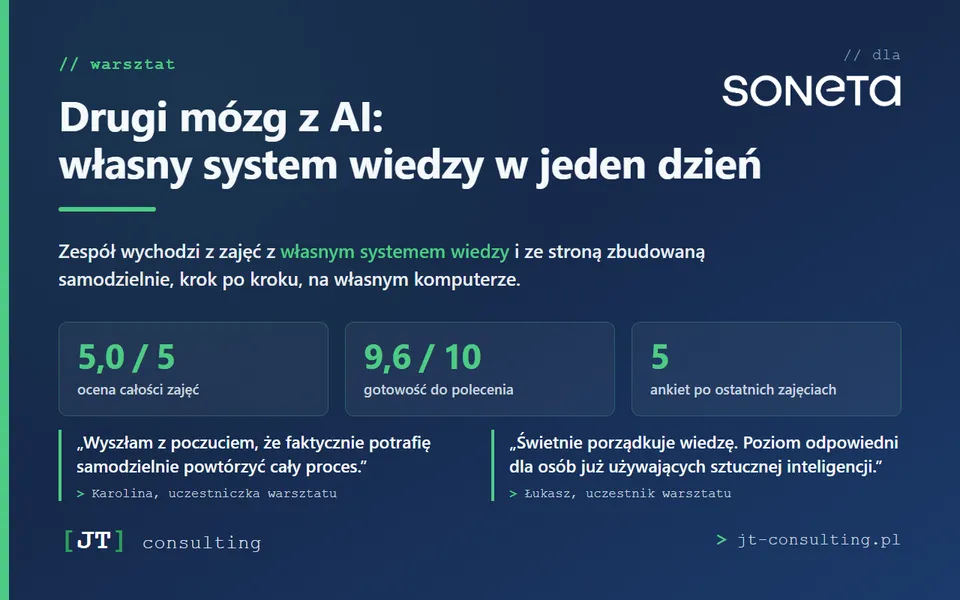
“Second brain with AI” is my original workshop, after which a team works with its own AI-supported knowledge system, and every participant leaves with a website they built with their own hands. I last ran it on July 10, 2026 for a project team at Soneta Sp. z o.o., a maker of ERP software for businesses: enova365 and TRIVA. The feedback forms from that day scored the overall experience and the clarity of the delivery at 5.0 out of 5 each, and put willingness to recommend at 9.6 out of 10.
Who the workshop is for
The last edition was ordered by Soneta, a maker of ERP software for businesses (enova365 and TRIVA), for its own project team. The workshop was built for teams that already use artificial intelligence tools daily, so another demonstration of what the tools can do would not have added anything. It answers a different question: how to manage your own knowledge so that decisions stop disappearing into chat history, and new material connects to what the team already knows. The course is hands-on from the first hour: every participant works on their own computer and builds their own knowledge system instead of watching the instructor work. This requires a personal Claude account on at least the Pro plan, because we work in Claude Code all day, plus a Google account to sign in to NotebookLM.
One day, three stages
The day follows a rhythm of “learn, build, publish”. The morning lays the foundation: a workspace with an AI assistant configured to remember decisions, and a knowledge notebook built from the participant’s own sources. At midday the work moves into Obsidian, where each person builds their own “second brain” vault and feeds it with their existing body of work, and by the end of the same day looks at it as a connected network of notes rather than a pile of files. The afternoon turns to production, and the vault yields, in turn, visual guidelines, a mockup, a description for the executing agents, and the site itself.
The real lesson is not any one of these tools, but three habits that recur through the whole day. The first is closing out a session, which is what moves decisions into lasting memory instead of losing them in the chat history. The second is feeding new knowledge back into the vault in a form connected to the rest. The third is separating thinking from execution: the plan lives in the knowledge base, and the execution happens somewhere else.
What stays after the workshop
The workshop comes with a tool website that walks through the seventeen blocks of the program and offers twenty-three cards of ready-made prompts to copy. The site remembers progress in the browser, so it shows which step is already done, and participants can return to any of them long after the workshop ends.
I built it using exactly the method the workshop teaches: the brief and the guidelines came out of the knowledge base, a team of agents assembled the code in a separate directory, and reviews for accessibility, security and content caught the gaps before publication.
What the survey showed
Every edition ends with a survey, because without measurement all that is left is the instructor’s own impression. In the five forms filled in after the July 10, 2026 session, the overall rating and the clarity of the delivery both came out at 5.0 out of 5, every answer to the question about expectations read “fully met”, and willingness to recommend reached 9.6 out of 10.
The same survey also showed the limit of the one-day format: three answers out of five rated the day’s pace as too fast, and while every participant did end up with a website, only one of them got it published that same day. That finding fed back into the program, so I now offer the same scope as either two days, or one day with a narrower scope, with time set aside for publishing.
Client reference
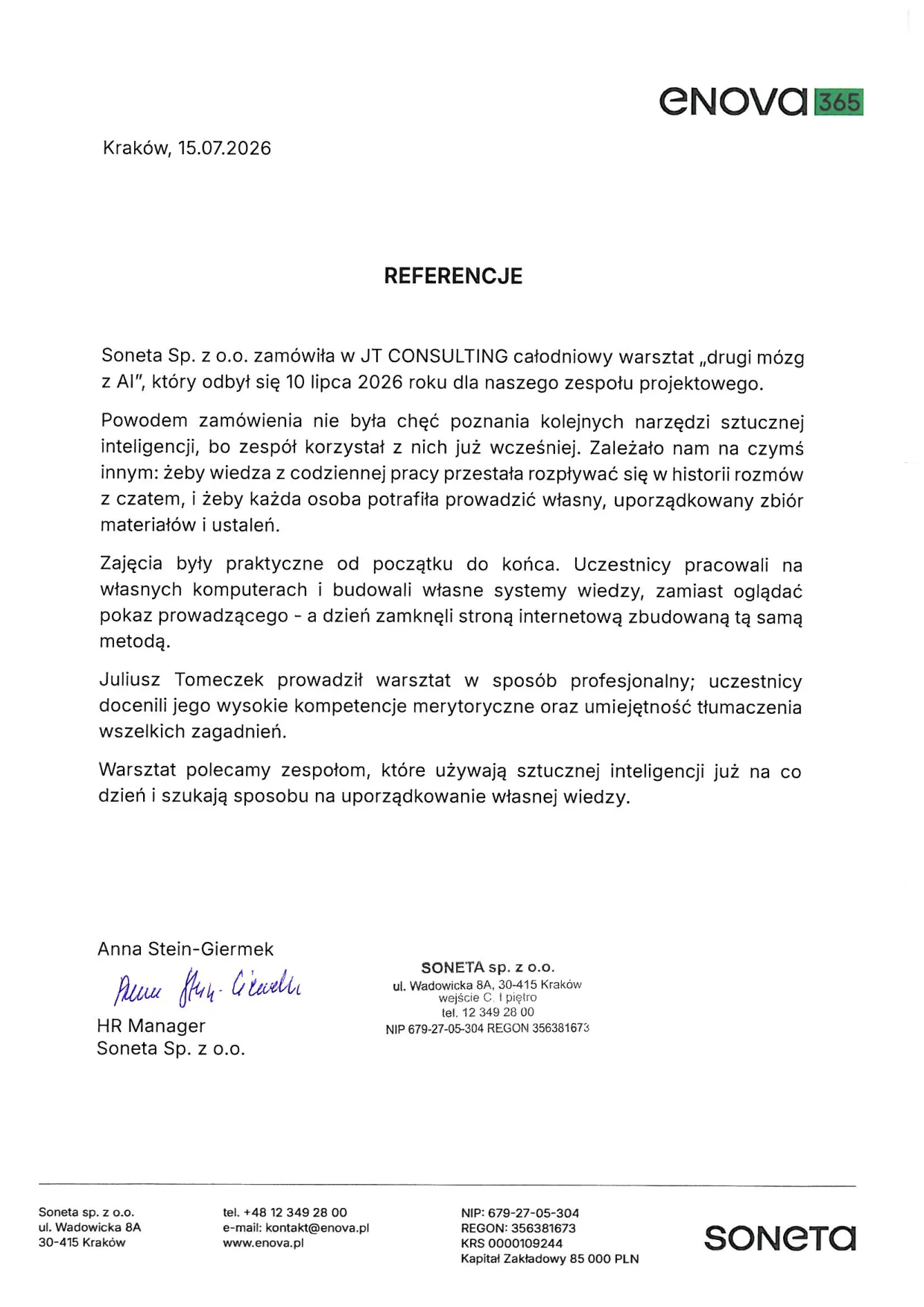
“The reason we ordered this was not to learn about more AI tools, because the team was already using them. What we needed was something else: for knowledge from everyday work to stop dissolving into chat history, and for every person to be able to keep their own organized set of materials and decisions.
I recommend the workshop to teams that already use artificial intelligence daily and are looking for a way to organize their own knowledge.”
Participants’ voices
“Great at organizing knowledge. The level suits people who already use artificial intelligence.”
“I left with a real sense that I could repeat the whole process on my own.”
What follows from it
A single day is enough for a team to leave with a method and a working knowledge system, provided that the whole time is spent building something real rather than practicing on examples. The published website is the test in this workshop, not the topic: it shows that knowledge gathered in the morning can turn into a finished piece of work by the afternoon. One more thing matters here: after a day like this, the team keeps working on its own, without depending on me.