
Digital Mentors Hub: an expert’s website and a server running open-source tools
- Client
- Damian Skipioł, Digital Mentors Hub
- Industry
- mentoring for AI and data transformation
- Scope
- Polish and English website, forms that send inquiries to a CRM, a VPS running open-source tools, backups, and monitoring
- Tools
- Astro, Umami, Twenty, n8n, Uptime Kuma
- Year
- 2026; since October, ongoing technical care and help with promoting the site
- Website
- digitalmentorshub.com
Services in this project:
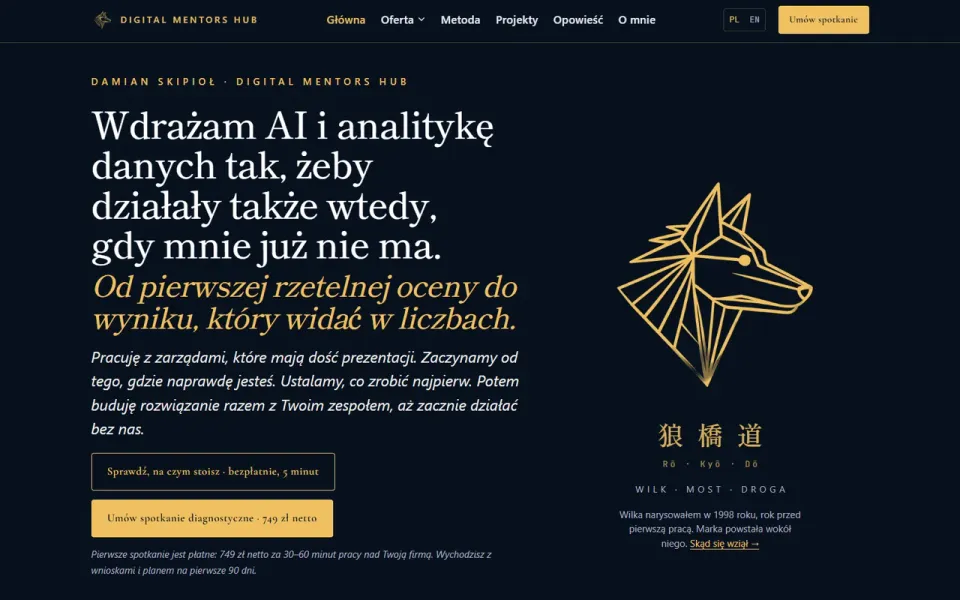
For Damian Skipioł, an AI and data transformation mentor, I built a bilingual website from his mockup and set up open-source tools on a server he owns. His form submissions and analytics stay under his control, and his automations run there too.
The client and the task
Damian Skipioł runs Digital Mentors Hub, where he guides leadership teams through AI and data transformation. He also teaches a course at Katowice Business University on using AI in research and at work. He came to me with the groundwork already done: a website mockup, a brand book, and audience personas. The task had two parts. The first was to turn the mockup into a Polish and English website that search engines can read and people with disabilities can use. The second was to set up infrastructure on Damian’s own server that keeps his data, meaning form submissions and visitor analytics, under his control and runs his automations.
What was built: the website
The mockup stayed the foundation of the site rather than a draft to be redesigned. The look, the structure, both language versions, and the self-assessment questionnaire for visitors all come from Damian. I added what a mockup doesn’t show. I rebuilt the design as a fast static site and copyedited the content, resolving 39 inconsistencies along the way. I set up automated WCAG accessibility tests that run before every release, added compression and caching, and implemented structured data that helps search engines and AI models recognize the person, the business, and the services. Visitors start with a free self-assessment (opens in a new tab) and only then book a paid diagnostic session.
The mockup arrived in early September 2026. The first release went live on September 30 and the English version on October 4. Search engines were allowed to index the site starting October 13, and since October 20 the forms have been sending inquiries to the CRM on Damian’s server.
What was built: the server
The website and the tools run on Damian’s own VPS, which I administer. If the term is new to you, see what a VPS is. Every change goes live only after it has been checked on a staging site.
The server runs four open-source tools. Umami counts visits without cookies. Twenty is the CRM where form inquiries land. Automations run in n8n, which handles the forms and the server’s maintenance checks. Uptime Kuma monitors more than a dozen services and the backups, and it sends an alert as soon as something fails. Backups run daily. They are encrypted on the server before they leave it, a copy is also kept off-site, and restores are tested regularly. The tools update automatically.
In October 2026, I switched the forms from an external marketing platform to the CRM on Damian’s server. Notifications go out from his own domain through a trusted email delivery service.
What came next: ongoing care and promotion
I look after the technical side of the website and the server and ship new releases. I also help Damian promote the site: I support his presence on LinkedIn and Facebook and measure traffic.
What this project shows
An expert with a clear vision for their website doesn’t have to hand it over for a redesign: their mockup can remain the foundation while the developer adds everything a design file leaves out. Form data and analytics can stay on the client’s server rather than on someone else’s platform. Running your own server does take ongoing care, though: backups, monitoring, and updates are part of the service, not an add-on.